
Quick Answer
A BF charging chute is a wear-resistant mechanical component used in the top charging system of a blast furnace to guide and distribute iron-bearing materials, coke, fluxes, and other burden materials onto the stockline of the furnace. In modern bell-less top (BLT) systems, the chute rotates around the furnace axis and changes its inclination angle, enabling operators to control the landing point of the burden across the furnace radius. Research published in the Journal of Process Control and Ironmaking & Steelmaking shows that the motion of the chute directly influences the trajectory, radial distribution, and segregation of the burden, as well as the distribution of gas flow, and ultimately the operation of the furnace.
In practical terms, the BF charging chute is much more than a simple material guide. The accuracy and repeatability of burden distribution are affected by its geometry, inclination, rotational speed, surface condition, cooling arrangement, and wear resistance, making it a critical component of modern blast furnace top-charging equipment.
What Is a BF Charging Chute?
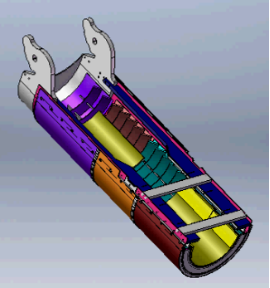
A BF charging chute is a chute or distribution spout located in the upper charging equipment of a blast furnace. Its primary function is to receive burden materials from the charging system and guide them towards the desired location on the furnace stock surface.
'BF' stands for 'blast furnace', while 'charging' refers to the controlled introduction of solid raw materials into the furnace. Depending on the ironmaking process and furnace design, these materials can include sinter, pellets, lump ore, coke, limestone, dolomite, and other additives. The charging system must deliver these materials in a controlled sequence and distribution pattern, rather than simply dropping them into the centre of the furnace.
The charging chute is particularly important in bell-less top charging systems, where a rotating chute replaces the large bell mechanism used in older blast furnace charging arrangements. It can rotate around the centreline of the furnace while its inclination changes, enabling the burden to be distributed in rings, spirals, sectors or other programmed patterns. Early industrial experience at Kawasaki Steel's Chiba No. 2 blast furnace demonstrated the ability of a bell-less top charging system to control radial burden distribution through chute rotation and inclination.
Where Is the BF Charging Chute Located?
The charging chute is installed near the top of the blast furnace, either inside the bell-less top or another top-charging assembly. It is positioned downstream of the charging hopper, the flow-control equipment, and the central material passage, and upstream of the furnace stockline.
In a modern bell-less top system, a simplified material path is as follows:
Stockhouse → conveyor or skip → receiving/charging hopper → lock hopper or material bin → flow-control gate → central throat → rotating charging chute → furnace stockline.
The exact arrangement of the equipment varies between blast furnace designs. Systems with parallel hoppers, for example, can use multiple storage and weighing arrangements before the material reaches the central throat and rotating chute. A 2017 study of a 4,070 m³ blast furnace modelled a bell-less top consisting of bunkers, a main feeding belt, a switch chute, two parallel hoppers, a central throat tube, a rotating chute, and a furnace throat.
This location exposes the chute to a challenging combination of conditions, including abrasive solid particles, elevated temperatures, mechanical impact, dust, repeated rotation and inclination movements, and the pressure-sealing requirements associated with the operation of modern blast furnaces.
How Does a BF Charging Chute Work?
While the operating principle is relatively straightforward, the actual material trajectory depends heavily on the geometry of the equipment and the operating conditions.
First, the material is discharged from the bin via a controlled gate. The material then enters the central passageway and falls onto the rotating chute. As the chute rotates around the furnace axis, its surface carries the material towards the tip of the chute.
The angle of inclination of the chute determines how far the material travels radially before leaving the chute. A steeper or shallower angle changes the particle velocity and trajectory, enabling operators to position the material closer to the centre of the furnace or further towards the wall.
After leaving the tip of the chute, the particles enter free fall and eventually impact the existing burden surface. Their final landing position is influenced by particle size, shape, friction, chute speed, chute angle, material flow rate, and stockline geometry. Research on bell-less top systems has modelled this trajectory both mathematically and experimentally, as the resulting burden profile is directly related to furnace gas distribution.
Why Is the Charging Chute Important?
The significance of a BF charging chute comes from the fact that burden distribution controls much more than where raw materials happen to land.
Inside a blast furnace, descending solid burden interacts with rising reducing gas. The distribution of ore-bearing materials, coke, and fluxes affects permeability and the available pathways for upward gas flow. Uneven charging can create local differences in layer thickness, particle-size distribution and void structure, which can then influence gas distribution and furnace reaction conditions.
Radhakrishnan and Maruthy Ram's mathematical model of bell-less top charging showed that the chute and charging pattern can be used to establish a desired stockline geometry. The study linked charging distribution with burden descent, gas-solid interaction, and furnace productivity, illustrating why the charging mechanism is an operational control device rather than merely a transport component.
More recent numerical work has reinforced this relationship. A 2021 study in Ironmaking & Steelmaking modeled burden trajectories from a tilting chute and used the resulting material distribution to estimate gas-flow distribution across the furnace radius.
What Materials Does a BF Charging Chute Handle?
The chute may handle several types of blast furnace burden, depending on the charging practice.
Common materials include:
- Sinter
- Pellets
- Lump iron ore
- Coke
- Limestone
- Dolomite
- Other fluxes and additives
These materials do not behave identically. Coke is relatively large, strong, and porous, while sinter and pellets have different density, size distribution, and impact behavior. Fine particles are particularly important because they can segregate during transportation and charging.
Particle-size segregation is a recognized issue in bell-less top charging. A 2024 study using three-dimensional discrete element modeling found that particle-size segregation occurs during charging and discharging in hopper systems, with smaller particles tending to accumulate toward particular stages of the discharge process. The research also showed that charging sequence and chute-angle adjustments can influence this behavior.
Consequently, a BF charging chute must be designed around the actual burden characteristics rather than treated as a generic steel plate or simple conveyor component.
Main Design Features of a BF Charging Chute
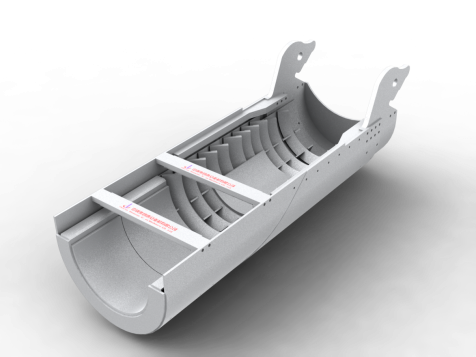
A modern charging chute typically incorporates several design features intended to balance distribution accuracy, mechanical reliability, and service life.
- Chute Geometry
The cross-sectional shape, length, width, and curvature influence the trajectory of particles. Research has demonstrated that changing the chute cross-section can alter particle movement and the resulting burden distribution, meaning geometry is directly related to process performance.
- Adjustable Inclination
The ability to change the chute angle is one of the defining characteristics of a bell-less top system. By changing the angle during rotation, operators can control the radial landing position of the burden and create different stockline patterns.
- Rotational Drive
The chute must rotate reliably around the furnace centerline. Rotation speed and positioning accuracy influence the circumferential distribution of material and therefore the repeatability of the charging program.
- Wear Protection
Because the chute is directly exposed to abrasive ore, sinter, coke, and flux, wear protection is essential. Replaceable wear plates or wear-resistant materials are commonly used in areas subject to concentrated material impact and sliding abrasion. Industrial descriptions of bell-less top equipment specifically identify replaceable wear components as part of the charging-system design.
- Cooling and Thermal Protection
Depending on the design and furnace operating conditions, thermal management may be necessary to protect the chute and associated mechanical components. The design must maintain dimensional stability and mechanical reliability while exposed to the hot furnace environment.
| BF Charging Chute Feature | Primary Function | Why It Matters |
| Chute Length | Controls material discharge radius | Influences where particles can reach |
| Inclination Mechanism | Adjusts radial trajectory | Enables center, intermediate, and peripheral charging |
| Rotation System | Controls circumferential distribution | Creates rings, spirals and other charging patterns |
| Wear Lining | Protects the chute body | Extends service life under abrasive burden |
| Chute Cross-Section | Controls particle flow | Influences velocity and trajectory |
| Drive Mechanism | Provides rotation and positioning | Determines charging accuracy and reliability |
| Cooling / Thermal Protection | Controls operating temperature | Protects structure and mechanical components |
| Inspection Access | Supports maintenance | Reduces downtime during service |
What Is the Difference Between a BF Charging Chute and a Bell?
In a traditional bell charging system, a bell-shaped component is used to distribute the burden into the furnace. In contrast, a bell-less top uses a rotating and tilting chute.
The bell-less design was developed to provide substantially greater flexibility in burden distribution. Rather than relying on fixed bell geometry, the chute can be adjusted in terms of inclination and rotation in order to place material at various radial positions.
Historical operations at Chiba No. 2 demonstrated that the bell-less top could use multiple predetermined chute angles and controlled rotation to achieve various burden distribution patterns. This system was introduced specifically because of its greater flexibility in controlling the burden profile.
Consequently, modern bell-less top systems provide operators with considerably more control over the stockline profile. Further research at Chiba No. 6 investigated reverse-forward tilting and advanced burden-distribution control, demonstrating how chute motion can be used as an active furnace-control parameter.
How Does the Charging Chute Affect Burden Distribution?
The charging chute influences burden distribution through three closely related variables: trajectory, impact location, and accumulation pattern.
When the chute rotates, the material leaves the tip at an ever-changing circumferential position. If the inclination angle changes during rotation, the radial landing point also changes. This enables the operator to create concentric or overlapping rings, spiral patterns, or localised distributions.
The resulting stockline is not solely determined by the chute angle. Particle size and angle of repose also matter because different particle sizes can travel and accumulate differently after impact. A 2021 computational study modelled particle trajectories and stockline formation specifically using chute inclination and particle behaviour. Earlier work developed mathematical relationships between charging parameters and burden distribution.
This is why the same chute setting may not produce the same material profile if the burden's particle size distribution, moisture content, or flow rate changes.
BF Charging Chute Wear and Common Failure Problems
Wear is one of the most important maintenance concerns for a BF charging chute. The chute is continuously exposed to high-volume streams of abrasive solids, and the most heavily affected regions are normally associated with material impact and sliding.
Typical problems can include:
- Liner or wear-plate erosion
- Localized thinning of the chute body
- Deformation caused by mechanical or thermal loading
- Damage around attachment points
- Drive or bearing problems
- Sealing-related issues
- Loss of chute-angle positioning accuracy
Wear does not only shorten equipment life. A change in chute geometry can alter the particle trajectory, meaning that a physically worn chute may gradually become a process-control problem as well as a maintenance problem.
For this reason, inspection should consider both remaining material thickness and actual charging performance. If the burden profile begins to deviate from the expected pattern, the cause may involve mechanical wear, drive accuracy, particle segregation, material flow conditions, or changes in the charging program.
How Can BF Charging Chute Performance Be Improved?
Improving chute performance begins with accurate control of the entire charging system rather than simply increasing chute speed.
First, control material flow. The flow-control gate should deliver a stable and predictable burden stream because variations in feed rate can change particle velocity and therefore the landing position.
Second, maintain chute geometry. Wear plates and structural components should be inspected regularly so that the chute retains its intended profile.
Third, calibrate inclination and rotation. The programmed angle must correspond to the actual physical angle, while rotational positioning must remain accurate throughout operation.
Fourth, monitor burden distribution. Stockline measurement, profile monitoring, and mathematical or discrete-element models can be used to compare actual distribution with the intended charging pattern. Modern research increasingly combines physical measurements with simulation to understand how charging parameters affect burden distribution and gas flow.
Finally, consider particle segregation. Even a perfectly controlled chute cannot completely compensate for significant segregation upstream in the hopper or feeding system. The 2024 Wiley study demonstrates that segregation can develop before the burden reaches the final charging stage, so improving chute performance may require improvements throughout the charging chain.
How Is a BF Charging Chute Selected?
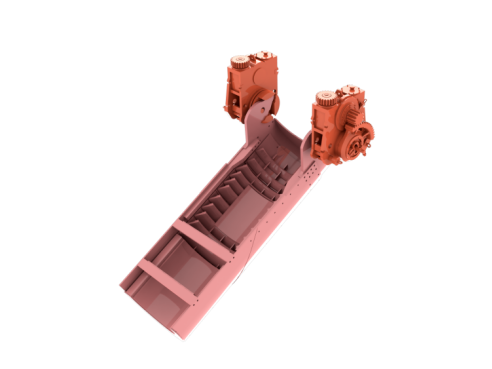
Selecting a BF charging chute requires more information than just the volume of the furnace. The designer should consider the following factors: furnace diameter; charging rate; burden composition; particle-size distribution; maximum particle size; chute length; required radial distribution; rotational speed; inclination range; and expected operating life.
The wear environment of the chute is equally important. A system that handles large quantities of abrasive sinter and coke will have different requirements from one that handles a different burden mix. The expected maintenance strategy should therefore be incorporated into the design from the outset.
Another important consideration is the desired charging pattern. If precise centre charging, peripheral charging, multi-ring charging, or spiral patterns are required for furnace operation, the chute drive and inclination system must provide the necessary range and positioning accuracy. Research on bell-less top systems consistently demonstrates that chute angle and rotation are key factors in controlling burden distribution.
| Selection Parameter | Key Question | Effect on Chute Design |
| Furnace Diameter | How large is the stockline area? | Determines required discharge reach |
| Charging Rate | How much burden passes through per unit time? | Influences structural and wear requirements |
| Burden Type | Ore, sinter, pellet, coke, or mixed burden? | Determines impact and abrasion characteristics |
| Particle Size | What are the minimum and maximum sizes? | Affects flow and segregation |
| Charging Pattern | Rings, spiral, center, or peripheral? | Determines control range |
| Inclination Range | How far must the material be distributed radially? | Defines chute movement requirements |
| Rotation Accuracy | How precise must circumferential distribution be? | Influences drive and control system |
| Wear Life | What maintenance interval is required? | Determines lining and material selection |
| Thermal Conditions | What temperature exposure is expected? | Influences cooling and structural design |
| Maintenance Strategy | How quickly must the chute be inspected or replaced? | Affects modularity and accessibility |
Why Is BF Charging Chute Technology Becoming More Advanced?
Modern blast furnaces are increasingly being operated as an integrated system, treating the top-charging mechanism as an operational control system rather than merely a material-handling mechanism. The reason for this is straightforward: the distribution of the burden influences gas flow, permeability, thermal conditions, and reaction efficiency.
Advanced mathematical models can now predict particle trajectories and stockline formation based on chute settings. Research conducted by the ISIJ International in 2015 developed a comprehensive model of the flow-control gate, the rotating chute, and the stock surface. Later studies have incorporated discrete-element methods to simulate particle-size segregation and burden movement.
These developments support more sophisticated charging strategies. Rather than relying entirely on fixed operator settings, modern systems use measured stockline data, burden characteristics, and process models to adjust the angle of the chute and the charging sequence.
The long-term direction is therefore towards model-assisted, data-driven burden distribution control. While the mechanical chute remains essential, its value increasingly comes from its ability to accurately execute a digitally defined charging strategy.
BF Charging Chute and Furnace Efficiency
A BF charging chute itself does not directly reduce fuel consumption or increase hot metal production. However, its contribution is important: it enables the furnace operator to establish and maintain an appropriate burden distribution.
A well-controlled burden profile can support a more consistent gas flow throughout the furnace. Conversely, poor distribution can create localised regions of high or low permeability, which may contribute to unstable furnace operation.
Research published in ISIJ International and other metallurgical journals consistently highlights the significance of burden distribution in influencing gas flow and furnace performance. For example, a 2024 study states that burden distribution affects gas-flow distribution, thermal efficiency, and fuel consumption, thereby reinforcing the importance of controlling particle movement during charging.
Therefore, the BF charging chute should be evaluated as part of the furnace's overall process control architecture. Its mechanical reliability, geometric accuracy, and condition with regard to wear can all influence the consistency of the burden profile.
FAQs About BF Charging Chute
- What is a BF charging chute?
A BF charging chute is a mechanical component used at the top of a blast furnace to guide and distribute burden materials into the furnace. In modern bell-less top systems, it rotates and tilts to control where materials land on the stockline.
- What does BF stand for in BF charging chute?
BF stands for blast furnace. A BF charging chute is therefore a chute specifically associated with the charging system of a blast furnace.
- What materials are charged through a BF charging chute?
Common materials include sinter, pellets, iron ore, coke, limestone, dolomite, and other additives. The exact burden composition depends on the blast furnace process and operating practice.
- How does a bell-less top charging chute work?
Material falls from a charging hopper onto a rotating chute and then travels toward the chute tip before falling onto the furnace stockline. Changing the chute's rotation and inclination allows operators to control the radial and circumferential distribution of the burden.
- Why does a BF charging chute need wear-resistant materials?
The chute continuously contacts abrasive burden such as sinter, ore, and coke. Wear-resistant liners and replaceable wear components help maintain the chute's geometry and extend operating life.
- How does a charging chute affect blast furnace performance?
The chute determines where burden materials are deposited, which affects the stockline profile and the distribution of gas-flow pathways through the furnace. Consistent burden distribution is therefore important for stable furnace operation, permeability, and process efficiency.
Conclusion
A blast furnace (BF) charging chute is a critical component of the top-charging system that controls the trajectory and distribution of solid burden materials. In a modern bell-less top, the chute's ability to rotate and tilt enables operators to position coke, sinter, pellets, ore and fluxes at controlled radial and circumferential locations, thereby creating the desired stockline profile.
The chute's importance extends well beyond material handling. Chute geometry, inclination, rotation accuracy, wear conditions and particle flow behaviour all influence burden distribution, which in turn affects gas flow, permeability, thermal efficiency and furnace stability. This relationship has been demonstrated through industrial studies, mathematical modelling and more recent discrete-element simulations.
For this reason, the choice or maintenance of a BF charging chute should be approached as a decision involving both mechanical engineering and process control. A reliable chute must be able to withstand abrasive and thermal conditions while maintaining its designed geometry and executing the charging pattern accurately. When these requirements are met, the chute becomes an important tool for achieving stable and controllable blast furnace operation.